Institute of Medicine
The Deer KingThe Institute of Medicine is the research institution at the Otawalle Academy of Deeper Learning where Hohsalle directs a research wing and pursues medical inquiry that challenges Zolian orthodoxy. Its work turns the investigation of Black Wolf Fever into more than a search for treatment: it exposes a deep disagreement over how disease should be understood, who may define medical knowledge, and whether patients should be offered a chance to resist illness.
Identity and Leadership
At twenty-six, Hohsalle directs the Institute of Medicine’s research wing. Trained by his grandfather, the renowned physician Limuelle, he began teaching at the Academy of Deeper Learning at fifteen and had already become known across the Zolian ruling class for his medical skill. His prominence followed his role in helping Limuelle cure Emperor Natalu’s wife, but he had also saved other people from severe illness and injury.
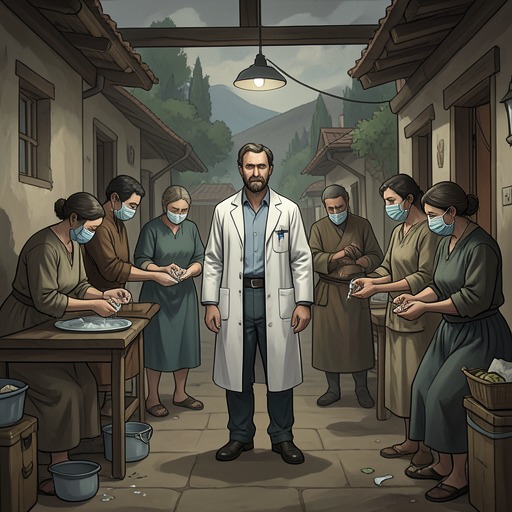
The Institute’s work is connected to Hohsalle’s clinic in Kazan, Chimya Tolosse, which includes three research wings and a residence for him and his assistants. When the bodies of Black Wolf Fever victims are brought there, his longtime assistant Milalle begins examining them with other aides. The scene shows research as collective labor: Hohsalle’s leadership depends on the assistance of people who handle the investigation and help turn an urgent discovery into a program of study.
Research and the Black Wolf Fever Investigation
The recovered corpses offer evidence that could not be obtained from living patients alone. Hohsalle observes that each body bears dog-bite marks and a rash across the body, directing attention away from suspected food poisoning and toward illness following bites. He explains that Black Wolf Fever can be carried by wolves and wild mountain dogs called ossam, and that fleas or ticks that have bitten infected animals or people can transmit it as well. The investigation therefore links close observation of the bodies to questions about routes of infection and the danger of spread.
Milalle describes the corpses as a source of several possible lines of research. The disease agents might be identified and weakened to produce an attenuated infection that could build resistance; researchers might also find substances that suppress or eliminate the illness. A further possibility is that infected people developed antibodies that could be used to make a serum to help other patients fight the disease. These are research prospects, not completed results, but they give the Institute a concrete program: identify the cause, test ways to prevent illness, and seek treatments for those already infected.
The researchers’ explanations also make their method intelligible to collaborators. Hohsalle compares the body’s defenses to soldiers with different tasks, who must learn to recognize a specific disease and be equipped to fight it. He explains that weakened disease agents can teach the body to identify an invader, drawing on Limuelle’s discovery of why some illnesses are contracted only once and his method of introducing weakened agents. The analogy translates an unfamiliar medical theory into terms that Yotalu can follow, supporting discussion of preventive treatment rather than leaving the inquiry confined to specialists.
Conflict over Medical Authority
The Institute works against a powerful religious framework. In the Pure Heart Creed, physicians are regarded as the fingers of the god, and medical practice is expected to follow divine teaching. When priest-doctors judge a condition incurable, accepted practice is to leave the patient to the god and offer only medicines that ease the process of dying. Otawalle medicine, with its willingness to seek causes and possible cures, is consequently treated as heretical even when it offers another possibility to patients and their families.
That conflict became politically visible when Emperor Natalu summoned Limuelle and Hohsalle to treat his gravely ill wife, despite advisers’ objections to Otawalle remedies. Their success led him to ask them to remain as palace physicians and teach the priest-doctors. The doctors’ opposition produced a clash between the priest-doctors’ association and the emperor; Limuelle and Hohsalle ultimately declined the offer, but the episode spread news of Otawalle medicine among the aristocracy. Nobles later sought its physicians covertly after being told by priest-doctors that their illnesses were incurable. A decade after the empress’s recovery, the medical science remained officially heretical, while the priest-doctors warned that departing from the creed could imperil the empire.
Cooperation and Its Limits
During the Black Wolf Fever outbreak, Hohsalle does not send news to the Sacred Territory before seeking Yotalu’s father’s permission. The stakes of disclosure are political as well as medical: uncontrolled reports could panic the population and leave the realm vulnerable to invasion. Yotalu welcomes Otawalle support because his people lack knowledge of the disease, and reports that his father and brother take its dangers seriously. This consent gives Hohsalle a basis to seek advice and share the Academy’s knowledge, while leaving the handling of the court priest-doctors to political leaders.
The prospect of cooperation does not erase the disagreement over what medicine is for. Mana, a priest-doctor, declines Hohsalle’s offer to see the tiny organisms he identifies as causes of disease. Mana holds that examining the patient is sufficient: the task is to recognize the problem from the body’s condition and remove the obstacles associated with defilement, not to identify the particular organism. Limuelle recognizes the appeal of this approach, but argues that accepting death as settled in advance prevents investigation from opening new paths. He urges Hohsalle to find further chances to involve Mana in treatment, because winning priest-doctors’ support could loosen the restrictions on Otawalle medicine and bring greater resources and wider access to its knowledge. The Institute’s significance thus lies both in its research and in the contested institutional conditions under which that research might be accepted.